A common claim is Lanao del Sur the poorest province in the Philippines and contributes very little to the national economy. A review of official data from the Philippine Statistics Authority (PSA) suggests that this statement is only partially accurate.
While Lanao del Sur has historically been among the poorer provinces in the country, it is not consistently ranked as the poorest province in recent years. Likewise, it is not the province with the lowest economic output.
Is Lanao del Sur the Poorest Province in the Philippines?
Lanao del Sur is located in Mindanao and has a population of approximately 1.2 million people. The province is home to Marawi City and serves as a major cultural and economic center for the Maranao people.
The province faced economic setbacks following the 2017 Marawi Siege, which affected infrastructure, business activity, and investor confidence.
Poverty Analysis
According to PSA poverty statistics, the national poverty incidence among Filipinos was 15.5% in 2023.
Historically, Lanao del Sur ranked among the provinces with high poverty levels. However, recent PSA reports indicate that poverty levels have improved significantly across many municipalities within the province.
Some municipalities still record poverty rates above 40%, while others have shown substantial reductions compared to previous years.
This indicates that poverty remains a challenge, but the situation is not uniform across the province.
Economic Contribution Analysis
Economic contribution is often measured through Gross Domestic Product (GDP).
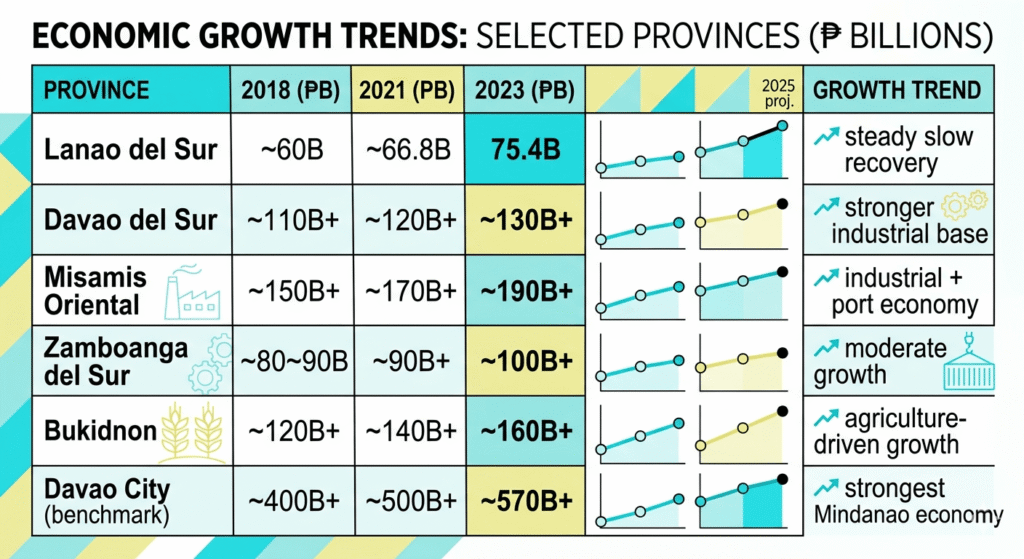
In 2023, the economy of Lanao del Sur was valued at approximately ₱75.4 billion.
For comparison:
- Cebu Province: over ₱700 billion GDP
- Laguna Province: over ₱1 trillion GDP
- Cavite Province: over ₱800 billion GDP
- Lanao del Sur: approximately ₱75.4 billion GDP
Although smaller than major industrial provinces, Lanao del Sur’s economy is larger than several other provinces in the country.
The province also recorded economic growth of around 5.0% in 2023.
Key Findings
- Lanao del Sur is not the richest province in the Philippines.
- Lanao del Sur remains one of the provinces facing significant poverty challenges.
- Lanao del Sur is not consistently the poorest province based on recent PSA data.
- The province contributes a relatively small share to the national economy compared with industrial provinces such as Cebu, Cavite, Laguna, and Batangas.
- Economic growth and poverty reduction have improved since the post-Marawi recovery period.
The statement that “Lanao del Sur is the poorest province in the Philippines and contributes the least to the economy” is not fully supported by current data.
A more accurate conclusion is:
“Lanao del Sur remains one of the historically poorer provinces in the Philippines, but recent data shows improving poverty indicators and economic growth. While its economic contribution is smaller than major industrial provinces, it is not the lowest among Philippine provinces.”
Search Visibility of Islamic Banking in the Philippines
One emerging indicator of economic potential is the growing online interest in Islamic banking and finance.
According to the article “Search Visibility of Islamic Banking in the Philippines” search demand and online discussions surrounding Islamic banking have increased as financial institutions and regulators promote Shari’ah-compliant financial services in the country.
Despite this growing interest, Fitch Ratings reported that Islamic banking assets in the Philippines amounted to only about USD 44 million as of the end of 2025, showing that the industry remains in its early stages compared with neighboring countries such as Malaysia, Indonesia, and Brunei.
This creates a significant opportunity for provinces with large Muslim populations, including Lanao del Sur. Greater awareness, digital visibility, financial literacy, and investment in Islamic finance could help attract capital, support entrepreneurship, and contribute to long-term economic development.
The case demonstrates that economic growth is not determined solely by existing industries. Search visibility and digital awareness can influence future investment, business creation, and financial inclusion.
References
- Philippine Statistics Authority (PSA) Poverty Statistics 2023
- PSA Municipal-Level Poverty Incidence Report (2023)
- PSA Provincial Product Accounts and Economic Performance Reports
Important note: Poverty incidence and total GDP measure different things. A province can have a growing economy while still having a large number of poor residents. Therefore, poverty ranking alone does not determine a province’s total economic contribution.